
A Shifting Approach
By Linda Berlin


Every February, I step into a cold, dark simulator to practice emergency maneuvers in a garden variety of safety-related scenarios over three days of intensive flight training. If I pass, I get to keep my day job flying passengers around the country. I used to dread this time of year because I really do like my job, but all of that has changed.
Training reminds me of a dress rehearsal for a play. I tweak small things that I have already learned and just need to practice. This is my third airline. I have been a captain in a turboprop and a mid-sized narrow body jet for two other airlines, so I have jumped through plenty of training hoops over the years. Instead of a perfect performance, I strive to sharpen the skills I’ve already honed. My approach to training has shifted drastically over the years.
I used to be a massive crammer. I would go about my busy life until a few days before training, then drop everything to obsess over limitations, aircraft systems, callouts, memory items and flight profiles. Back then, training rolled around every six months; way too often, in my opinion. I thought of it as a colossal inconvenience.
What I finally realized - and it took me years to figure this out - is that cramming just creates more stress that follows me right into the simulator. One sloppy mistake can bug me for days afterwards. Why not just get it right from the start? Cramming didn’t work anymore, so I started to experiment. And now, I’ve finally settled into a study routine that helps me excel.
I take an entire month to prepare, counting out the days on a calendar to make sure I put in four full weeks of time. The first half, I spend just one hour each day studying big picture stuff. It is the furthest thing from a cram session, but I’m strict about it. I turn off my phone. I turn on a timer. And I do nothing but study for sixty minutes first thing in the morning. Once I’m done, I go about the rest of my day doing whatever I want.
This year, training revolved around winter conditions. So I read the chapter on cold weather operations and reviewed icing charts and cold weather reference cards. I also studied flight manuals, standardization notes, and strategies from other pilots. Training is tribal. I love that about the airlines. Everyone, including the training department, wants me, and every other pilot on property, to succeed.
Two weeks out from training, I bump up my study to two hours per day, taking a break in the middle, but using a timer once again. In this round, I go deep into the weeds, reading over the minutiae including flight profiles, the airport charts where I’ll be flying in the simulator, and the special script for all single-engine operations, especially at the high altitude airports where an invisible pathway in the sky keeps me safe from terrain.
I’m much less likely to feel startled if I anticipate failures in advance. Engine failures, for instance, aren’t as earth shattering as one might think. How I work in a team setting is also evaluated. For the past two years, I’ve had the same captain because we prefer to train together. I’ve never done this before, but it’s great because we both get so much more out of it since we are equally prepared.
I have trained with captains who haven’t cracked a book and it tends to be painful. If a pilot doesn’t perform to a certain standard, they can be pulled off their schedule and eventually fired, but that’s a rare occurrence, and something I’ve never experienced.
Practicing engine fires, flight control malfunctions, high-altitude stalls, wind shears, airspeed unreliable, all things that can and do happen in the real world, may raise my blood pressure a bit, but after studying for an entire month, I’m more relaxed in my approach.
Like writing or acting, flight training can be demanding. It requires focus, especially when one is new to a company or when transitioning to a new aircraft. There is so much to learn. Annual recurrent training, however, is a different beast. For those of us who have flown the same airplane for several years, it’s a fight against complacency.
What motivates me is thinking of all the passengers I’ve met over the years who are terrified to fly, but still get on airplanes. They put their faith in me to fly them safely to their destination, so I study hard for them. And whatever curveball comes my way, I’ll manage it in a calm, steadfast way because I’m prepared for it.
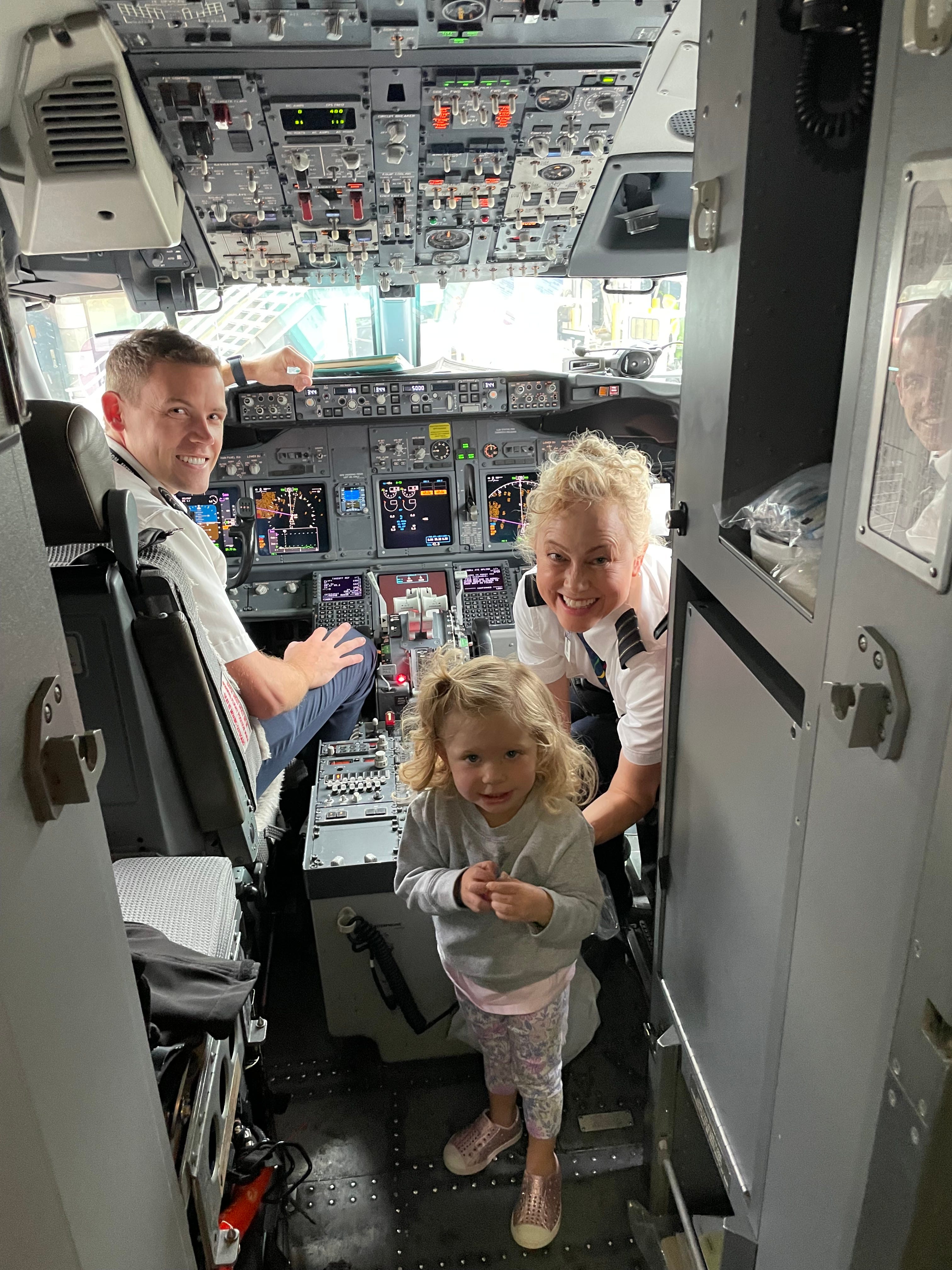
Wowza! I already loved you, and that was before I knew you were a badass pilot! I love knowing how much pilots have to retrain every year. With doors and bolts coming off mid-flight, it’s a relief to know the flight team is on top of it! Thanks for getting us to our destinations safely! And you look sharp in your uniform! ♥️